

The north aisle
This is where the immensity of the abbey church becomes apparent. So it is probably not by rushing into the central nave that it is best perceived, but rather by staying in the aisle and mowing slowly toward the transept.
The bases of the engaged columns have a variety of profiles that are not found in other parts of the building. As in the porch, the capitals at the top of the columns are decorated with simple leaves, typical of Cistercian buildings. [to go further]

The quotation
"It is this silence and simplicity
that give us the opportunity
to transform ourselves as we move
from clarity to clarity...
It is in this silence that we learn
and practice the great art
of moving in a straight line towards God.
Dedicated to such a purpose,
does our silence seem to you
silence and inertia?
Gilbert de Hoyland (+ 1172)
Gilbert de Hoyland, Letter to a certain Adam, 4: Patrologia Latina, vol. 184, col. 293 A.
The picture
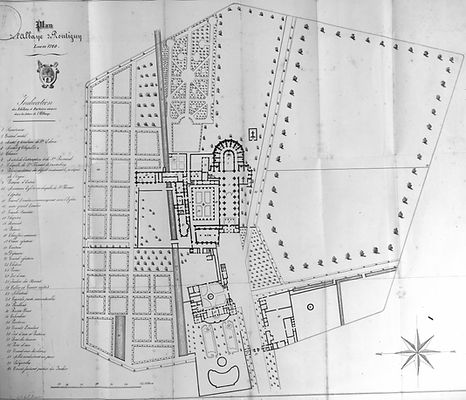
Plan of the abbey in the 18th century
V.-B. Henry, History of the abbey of Pontigny, Auxerre-Avallon, 1839
To go further
On the left, in the Middle Ages, a door opened onto the lay brothers' alleyway; further on, another door opens onto the monks' cloister, each group having its own access. The windows in the north aisle were walled up when the cloister was rebuilt in the early 18th century, so the aisle space was originally brighter than it is today.
Around the cloister were the lay brothers' wing to the west, the refectory wing to the north and the monks' wing to the east, in the extension of the transept.
Glossary
Aisle :
side aisle, or collateral aisle, lower than the main aisle in the nave.
Engaged column :
an engaged column is vertically built into a wall so that one part of is is embedded in the wall, while the other part (often a half) is protruding and visible.
Gilbert de Hoyland :
Cistercian abbot of Swineshead in England (Lincolnshire), who died in the Cistercian abbey of Larrivour (Champagne) in 1172; author of spiritual treatises.
Cloister :
covered walk in a monastery, convent or abbey, walled on one side and open on a quadrangle on the other. This remains a silent space devoted to prayer and meditation.